More than just evolution: How the DOSOMAT move is changing the rules of filling technology
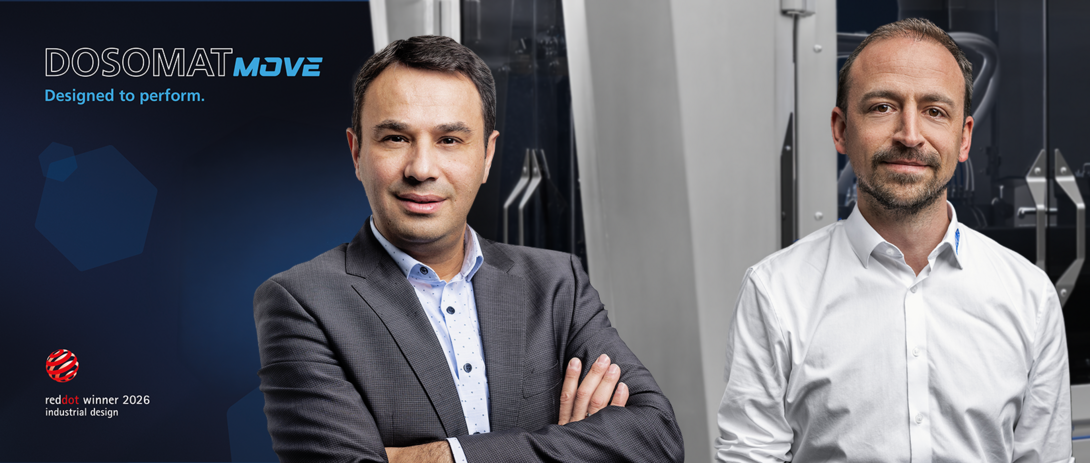
The requirements for modern production lines have changed fundamentally. Whereas long run times and standardized products used to dominate, today’s demands are for flexibility, quick format changes, and maximum uptime. With the DOSOMAT move, we therefore didn’t simply want to improve an existing system—we wanted to create an entirely new concept. The result is a solution that combines independent process lanes, high adaptability, and economic efficiency. In this interview, Adrian Hermann (Sales Manager) and Muhammer Kör (Business Unit Manager) from DOSOMAT Packaging Solutions explain which market requirements shaped the development, why modular system architectures are becoming a decisive competitive advantage, and what role artificial intelligence will play in packaging technology in the future.
Anyone developing a new production system today isn’t doing so in a vacuum. New market demands, changing production processes, and specific real-world challenges often set the direction. How was that the case with the DOSOMAT move? What was the deciding factor behind its development, and what role did your customers’ needs play in that?
Adrian Hermann: The impetus clearly came from the market. Our customers are under enormous pressure today: smaller batch sizes, more variants, and more frequent product changes. Many have told us that traditional production lines are too rigid and too costly for these demands. This led to the idea of developing a system that can truly handle these dynamics.
Muhammer Kör: We deliberately reimagined the design from the ground up—not based on existing machines, but on the requirements of modern production. The goal was a system that delivers flexibility, availability, and cost-effectiveness all at once. We’re also seeing a clear trend toward customized products and shorter product lifecycles. At the same time, demands for hygiene, efficiency, and sustainability are rising. This often no longer fits with traditional filling concepts. A key problem was that, on many systems, a single malfunction immediately brings the entire line to a halt. This is exactly where we come in—with independent lanes and an intelligently controlled product flow.
When did it become clear that we wouldn't just adapt and make a few changes here and there, but that we would have to completely rethink the concept? In other words: Is the DOSOMAT move more of an evolution or a true paradigm shift?
Adrian Hermann: To me, this is clearly a paradigm shift. We’re not talking about optimization in detail, but about a new way of thinking about production lines. With the DOSOMAT move, we’ve redesigned our packaging system from the ground up. This is evident, for example, in its architecture, which features individual stations and independent control—a principle that differs from that of traditional production lines.
How would you describe the development process for an innovation like this, and what was the biggest technical challenge?
Adrian Hermann: Our goal in developing the DOSOMAT move was the same as that of our customers: to significantly shorten time-to-market. That is why we designed the development process to be highly dynamic and consistently focused on rapid validation, optimization, and the integration of new requirements.
The greatest technical challenge was to combine maximum flexibility with reliable and cost-effective production. The goal was to create a system that could be quickly adapted to different products and formats without compromising performance, process reliability, or OEE.
What is the main difference between the DOSOMAT move and previous DOSOMAT systems, or other solutions on the market in general?
Muhammer Kör: Many systems are either flexible or efficient. The DOSOMAT move can do both—and that really sets it apart in the market. Its key feature is the combination of modular architecture, linearized product flow, and independent web control. This eliminates traditional bottlenecks and significantly increases uptime.
What role did communication with customers play during the development process?
Adrian Hermann: Communication with customers was essential. Many of today's features—especially those related to handling and format changes—are a direct result of customer feedback.
Muhammer Kör: We worked very closely with pilot customers and based our work on real-world production scenarios. Without this practical perspective, the project would not have been possible in this form.
What kind of feedback have you received from customers so far?
Adrian Hermann: The feedback on flexibility and quick format changes has been particularly positive.
Muhammer Kör: Customers particularly appreciate the high system availability and the fact that malfunctions no longer immediately affect the entire line.
What specific changes will production employees see in their day-to-day work, and what benefits will customers notice first?
Adrian Hermann: The first thing production teams notice is that the machine is easier to operate and can be retooled much more quickly. Format changes can sometimes be completed in under five minutes—and even without tools. This drastically reduces downtime.
Where are the greatest opportunities for cost savings in day-to-day operations? Is sustainability today more of a customer expectation or a genuine economic factor?
Adrian Hermann: Sustainability has long been an economic factor. Energy, materials, and efficiency have a direct impact on costs.
Muhammer Kör: For example, we reduce energy consumption and maintenance costs by using fewer components, and we apply principles such as “No-Cup-No-Fill” to prevent product loss.
Which aspects of the system are often underestimated but make a big difference? For example, to what extent does intuitive operation help address the shortage of skilled workers and reduce training costs?
Adrian Hermann: Usability is a major factor—especially in the context of a skilled labor shortage. In addition, ergonomics, a clear view of processes, and a consistent operating distance significantly reduce errors and training costs.
Where is the market headed over the next five to ten years? How is AI influencing filling and packaging technology? What demands will customers place on machine builders in the future?
Muhammer Kör: The market is becoming even more dynamic—more variants, shorter cycles, and greater customization. And when it comes to AI, there will be a lot of activity, particularly in the areas of predictive maintenance, process optimization, and adaptive control. In the future, machines will need to be able to respond even more autonomously.
Which aspect of the project are you personally most proud of?
Adrian Hermann: I am particularly proud that we have created a product that solves a real customer problem and offers genuine added value. But what impresses me most is the journey we took to get there. The DOSOMAT move is not the achievement of a few individuals, but the result of a team that worked toward a common goal with great dedication, creativity, and technical expertise.
When you see what can be achieved through genuine collaboration, it becomes clear: The best solutions rarely come from one person alone—they emerge when people combine their strengths and bring out the best in one another.
Muhammer Kör: For me, it’s the fact that we’ve successfully implemented a completely new system concept—from the initial idea to a market-ready solution. At the same time, we’ve found new ways to make this innovation accessible. In our digital showroom, customers can explore the DOSOMAT move and its features in detail and get a comprehensive overview of the system concept.
If you had to describe the DOSOMAT move in three words—what would they be?
Adrian Hermann: Flexible. Efficient. Future-proof.
Muhammer Kör: Modular. Smarter. More Consistent.