Plug & Play – How the connected laboratory is becoming a reality
Author: Moriz Walter (Head of Product Development Lab Space Solutions)
When discussing the digitalisation of laboratories, the focus is often on data platforms, automation or artificial intelligence. However, the foundation for this is often overlooked: devices and systems must first and foremost be able to communicate reliably with one another.
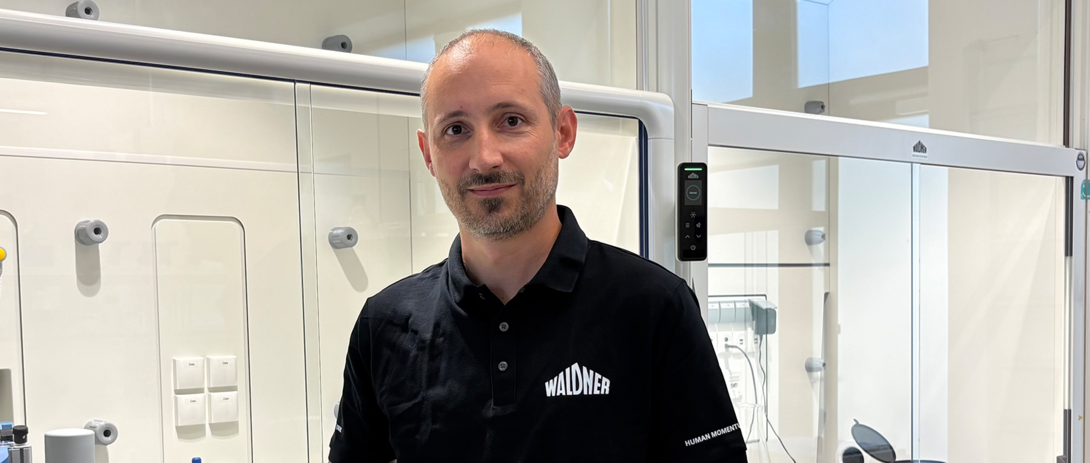
Moriz Walter, Head of Product Development at WALDNER Lab Space Solutions, with the LADS-compatible vacuum pump from VACUUBRAND in the Lab Control Centre.
This is precisely where WALDNER’s Lab Control Centre (LCC) comes in. The open platform connects devices, infrastructure and data sources across different manufacturers, thereby laying the foundations for digital laboratory processes.
For Moriz Walter, Head of Product Development at WALDNER Lab Space Solutions, this step represents a logical progression: “Digital integration was the next logical step for us.” WALDNER, together with VACUUBRAND, demonstrated how this vision works in practice at the Live Lab during analytica 2026.
A tried-and-tested partnership meets the digital future
WALDNER and VACUUBRAND have been working together for many years. The manufacturer’s vacuum technology is regularly used in laboratory projects and is therefore closely integrated into the laboratory infrastructure.
The LCC has now created the opportunity to take this proven partnership to a new level. Rather than simply being physically integrated, the equipment is to be digitally connected to the laboratory environment in future.
This is made possible by the LADS OPC UA communication standard, which is designed to ensure cross-manufacturer interoperability. Together with standards such as SiLA, it aims to enable laboratory equipment from different manufacturers to communicate with one another without the need for individual programming.
The endurance test at analytica
Shortly before the trade fair began, the LADS-compatible VACUUBRAND vacuum pump and the WALDNER Lab Control Centre were connected directly to one another for the first time. The conditions were deliberately chosen to reflect real-world scenarios: no complex custom integration, but rather a standardised connection via LADS OPC UA.
The result was clear. The integration worked straight away.
For Moriz Walter, this is precisely the key message: “This shows how quickly standardised interfaces can be used to implement fully functional end-to-end solutions – far more efficiently than with traditional custom integrations.”
Via the LCC, visitors to the trade fair were able to monitor the vacuum pump’s status in real time. Operating data and status information were displayed directly and were available centrally.
Why open standards are crucial
This successful demonstration is more than just a technical proof of concept. It highlights the potential of open communication standards.
Many laboratories are still struggling with siloed solutions today. Whilst devices do provide data, this data is often stored in separate systems. The result is a lack of data interoperability, additional integration effort and limited transparency.
With the LCC, WALDNER is taking a different approach. The platform collects information from various sources and makes it available centrally. This opens up new possibilities for monitoring, analysis, documentation and future automation.
For laboratory operators, this means not only greater transparency, but also more efficient processes and a better basis for data-driven decisions.
The Lab Control Centre (LCC) as a central data hub
The focus here is not on the individual piece of equipment, but on the interaction within the laboratory as a whole. The LCC acts as a central data hub. Equipment from different manufacturers can be integrated, data consolidated and processes viewed holistically.
The successful integration of the VACUUBRAND vacuum pump serves as a prime example of how this concept can work in practice. What applies to a vacuum pump today can be extended to numerous other laboratory instruments in the future.
The vision: the USB principle for laboratories
In the long term, Moriz Walter has a clear vision: laboratory equipment should be as easy to integrate as a USB device on a computer. Instead of having to undertake individual interface projects, users would be able to connect devices and access their data immediately. Open standards such as LADS OPC UA lay the groundwork for this. “Digitalisation in the laboratory is no longer a question of ‘if’ or ‘when’ – anyone who isn’t thinking about it now is already too late,” Moriz Walter is convinced.
The live demonstration at analytica 2026 showed that this journey has long since begun. And that, with the LCC, WALDNER is playing a central role in making digital connectivity a reality in everyday laboratory work.
This site uses third-party website tracking technologies to provide its services. I agree to this and can revoke or change my consent at any time with effect for the future.